Localising global campaigns: Local speed, global brand

HQ ships a beautiful global campaign, and it lands flat in your market. The casting feels foreign, the references miss, and the launch window closes while you wait for central approval to adapt it. If you run marketing for a regional office of a multinational, this is not an occasional annoyance. It is the structural shape of your job.
Localisation is how regional teams close that gap: adapting global campaigns so they feel native to each market while staying unmistakably on brand. Done well, it gives you local speed without putting the global brand at risk. This post covers why translation alone fails, a framework for doing it properly, and how to get the speed your market demands.
Why translation is not localisation
The cheapest response to a global campaign is subtitles and a dubbed voiceover. It is also the response audiences see through instantly. Video is the most culturally loaded format a brand ships: faces, locations, humour, pacing, and social context all read differently in Jakarta than they do in Frankfurt.
Real localisation changes what translation cannot:
People. Audiences notice within seconds whether the people on screen belong to their market. Local casting is the single biggest credibility signal in localised video.
Place. A skyline, a street, an office interior. Recognisable local settings tell viewers this content was made for them, not exported to them.
Context. Buying behaviour, regulatory references, business etiquette, and even what "professional" looks like vary by market. A creator who lives there gets this right by instinct.
This is why localisation quality depends less on post-production budget and more on who makes the content. A crew that knows the culture and the locations beats a bigger crew flown in from HQ.

A framework: The four layers of campaign localisation
Treat localisation as 4 layers, from lightest to deepest. Match the layer to the campaign's importance in your market, not to whatever budget is left over.
Layer 1: Language
Subtitles, voiceover, and on-screen text in the local language. Necessary, never sufficient. Use it alone only for low-stakes internal or evergreen content.
Layer 2: Substitution
Keep the global campaign structure but reshoot key elements locally: local presenter, local customer, local b-roll. The campaign stays recognisably the same worldwide while every market sees its own people and places. This is the workhorse layer for most regional teams.
Layer 3: Adaptation
Keep the campaign idea but rebuild the execution for the market: new script angles, market-specific proof points, local formats and channel cuts. Use it when the global concept is strong but the execution assumptions do not survive the cultural crossing.
Layer 4: Origination
Create market-first content within global brand guidelines: a local customer story, a regional event film, a market-specific launch video. This is where regional teams build the proof that gets HQ's attention, because it shows the brand can be both consistent and local.

Key challenges
Regional marketers face the same 4 obstacles in nearly every market:
Budget asymmetry. HQ runs the campaign on $100K and hands the region $10K for adaptation, with the same quality expectations. Without productised, predictable pricing, the maths never works.
Brand consistency anxiety. Everything you ship can end up in front of central brand. One off-brand variant can undo months of trust. You need a production path with brand governance built in, not bolted on.
Approval cycles that miss the moment. Local opportunities move at local speed. If onboarding a vendor takes 6 weeks, the launch window is gone before the first call sheet exists.
Vendor sprawl. A different production company in every market means different pricing, different quality, and a fresh onboarding tax per city. Multiply by 8 markets and localisation becomes a procurement project.
How 90 Seconds supports global campaign localisation
90 Seconds is a global video creation platform built for exactly this regional reality: one platform, local execution in every market, global brand control throughout.
Local Creator Partners everywhere you operate. Creator Partners are vetted video professionals in our global network: 14,000+ of them across 160+ countries and 1,500+ cities. They live in your market, know the culture and the locations, and shoot without flights or per-diems. Brief Monday. Shoot Friday.
Productize templates for regional orders. Define a localisation format once, with your brand guidelines embedded, then every market orders the same template. The Singapore cut and the São Paulo cut follow the same workflow, so quality stays consistent without central babysitting.
Brand governance built into the workflow. Your guidelines travel with every order, every revision is tracked, and central brand can review at any point. Regional speed stops being a brand risk.
Concierge support. A Concierge is a dedicated service manager who guides you through every step of creation, which matters when you are a team of 2 coordinating shoots across time zones.
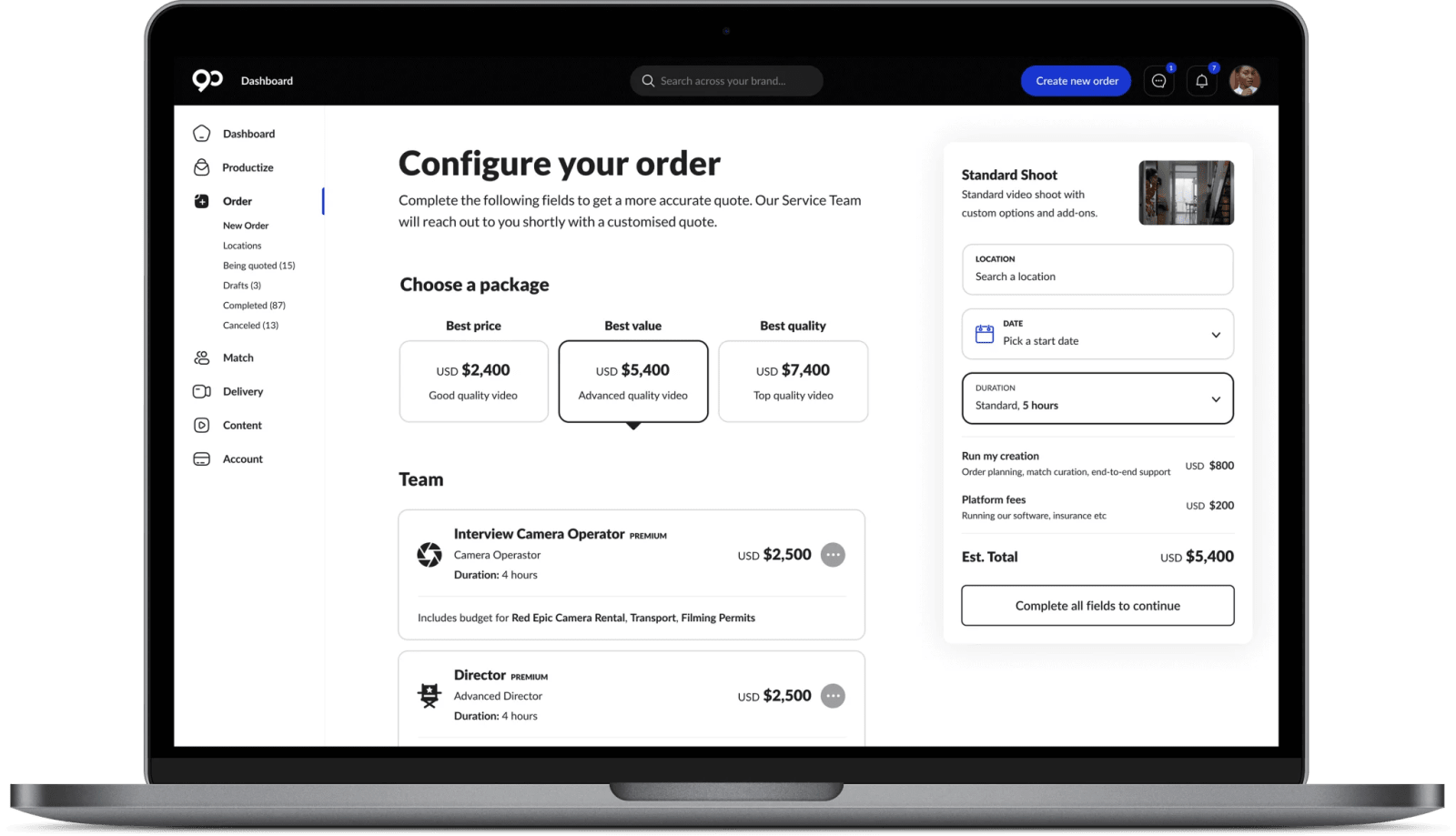
Transparent pricing and analytics. Know the price before you brief, defend the spend with delivery and performance data, and bring HQ a clean ROI story.
That last point matters beyond this quarter. Many of our largest enterprise accounts started with one regional marketer ordering one localised shoot. The work travelled: other regions adopted it, then central marketing consolidated on the platform. Over 13 years that pattern has produced 25,000+ shoots and 50,000+ videos for 4,500+ brands, including KPMG, HP, Microsoft, and Deloitte.
Start with one market, one campaign
You do not need a global mandate to fix localisation. Pick the next HQ campaign landing in your market, choose the right layer of localisation, and run it with local creators on a known price. When it outperforms the translated version, you have the proof your budget conversation has been missing.
Ready to localise with local speed and a global brand? Get started with 90 Seconds

90 Seconds
Content Team