
Why video needs a system of record
Ask your team where last quarter's video projects live and you'll get 5 answers: an email chain, a Dropbox link, a vendor's spreadsheet, a Slack thread, and someone's desktop. Now ask what you spent on video across all regions last year. If the answer takes 3 weeks and a finance analyst, you don't have a video operation. You have video chaos with a budget.
A system of record is the single platform where a business function's work is ordered, tracked, approved, and measured. Sales has Salesforce. HR has Workday. Finance has NetSuite. IT has ServiceNow. Video, despite being one of the fastest-growing content budgets in the enterprise, is the last major function still running on email and goodwill.
Why video is the next function to get one
Every function that adopted a system of record followed the same pattern. First, volume grew until ad-hoc management broke. Then spend grew until finance demanded visibility. Then the function was rebuilt around a platform, and the leaders who drove that change got promoted.
Video is at that inflection point now. Demand has exploded: social channels, sales enablement, internal comms, regional campaigns, and customer stories all need video, and enterprises that produced 20 videos a year now need 200. Spend has followed. Enterprise video is a market worth tens of billions of dollars, and a single global brand can easily run 5 to 15 production vendors with zero unified view of cost, quality, or output.
Meanwhile procurement is consolidating vendors across every category, and CFOs are scrutinising marketing spend harder than ever. "We don't actually know what we spend on video" is an answer that no longer survives a budget review.
What a system of record for video looks like
Six capabilities define it. If your current setup can't do all 6, you have point solutions, not a system.
Order
Anyone authorised, in any team or region, can order video from a defined catalogue with known pricing and known scope. No bespoke negotiation per project, no "email Dave who knows a guy in Singapore".
Track
Every project has a status, a Due Date, and visible milestones. A marketing leader can see every video in flight across the organisation in one view, the way a sales leader sees pipeline.
Review
Feedback, versions, and revisions happen in one place, attached to the asset, not scattered across email threads and conflicting comment chains.
Approve
Defined Reviewers and Decision Makers per project, so brand governance happens inside the workflow instead of bottlenecking it.
Store
Finished assets and their versions live in the platform, searchable and reusable, not on the laptop of someone who left in March.
Measure
Spend and output are visible by team, by region, and by content type. This is the capability that turns video from an opaque line item into a managed function. When the CFO asks what APAC spent on customer stories versus product videos, the answer is a filter, not a forensic project.

Key challenges
Why hasn't this happened already? Four reasons:
Video feels like a craft, not a process. Teams assume creative work can't be systematised. But ordering, tracking, and approving are operations, not creativity. Structuring them frees the creative work, it doesn't constrain it.
Fragmented supply. A system of record only works if production itself runs through it. With a different production company in every market, there's no single pipe to systematise.
Tool sprawl masquerading as a stack. A storage tool here, a review tool there, a project tracker somewhere else. Five subscriptions don't compose into one workflow, and none of them touches the actual production.
Nobody owns it. Video spend is scattered across brand, demand gen, comms, and regional budgets. Without an owner, nobody builds the system, and the chaos persists by default.
How 90 Seconds supports a system of record for video
90 Seconds is a global video creation platform, and Enterprise Platform mode is built to be exactly this: the system of record for video. Over 13 years we've delivered 50,000+ videos, 25,000+ shoots, and $100M+ in video for 4,500+ brands, including HP, Cisco, Barclays, KPMG, and Kyndryl.
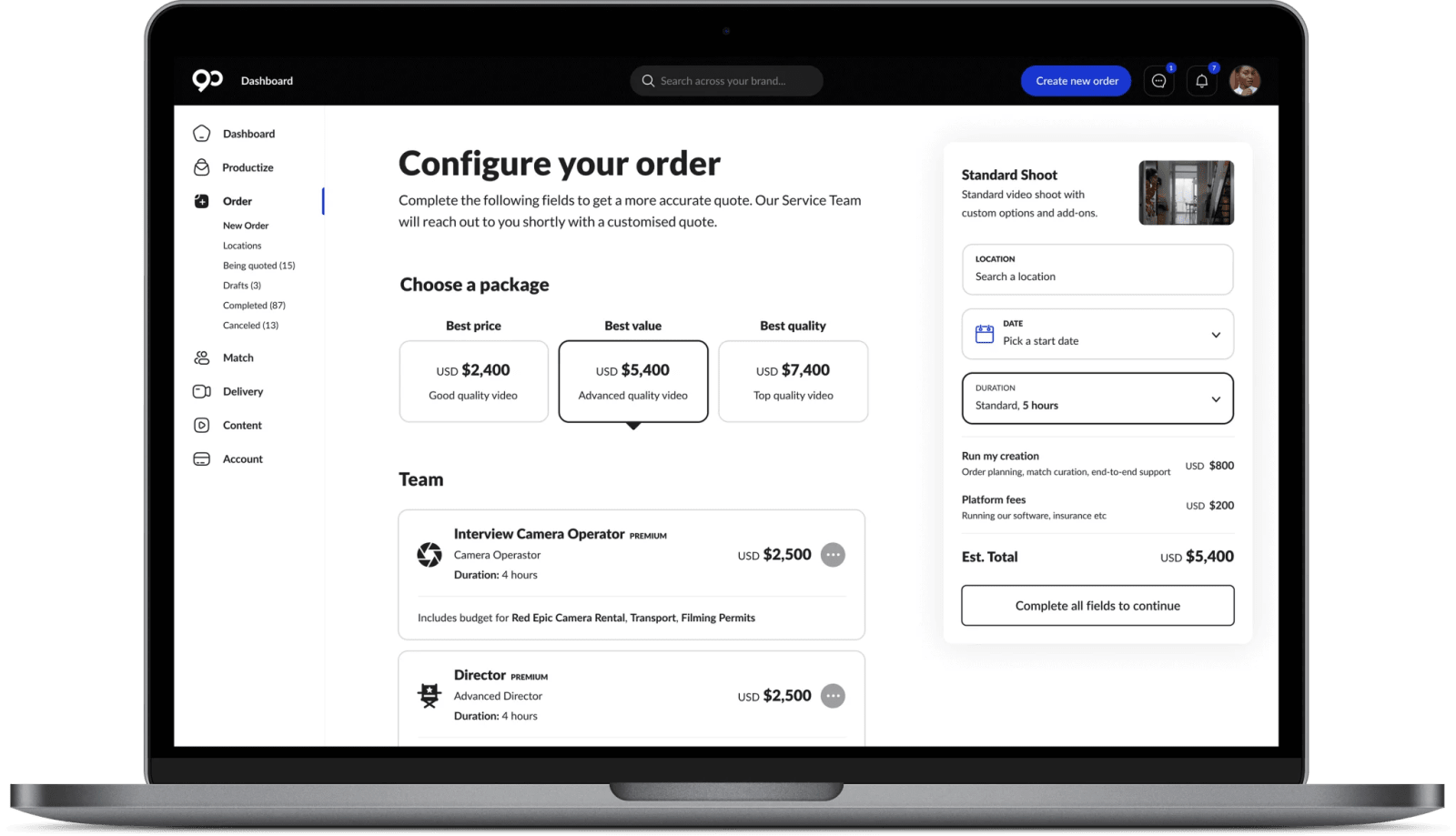
Ordering, matching, delivery, review, and storage in one place. Teams browse a catalogue and place orders with transparent pricing. The platform matches each project to Creator Partners, our network of 14,000+ vetted video professionals across 110+ countries and 1,500+ cities. Delivery runs on tracked milestones, review and approval happen against versioned assets, and finished work is stored centrally.
Production is in the system, not beside it. This is the difference between 90 Seconds and a project tracker. The crews, the shoots, and the edits run through the same platform that tracks them, so the record is the reality.
Productize the repeatable. Recurring formats, such as testimonials, event coverage, and product updates, become Productize templates that any team or region reorders with consistent scope, quality, and pricing. Region 5 gets the same result as region 1.
Concierge support at every step. Every order is guided by a Concierge, a dedicated service manager who keeps projects on track, so adopting the system never means losing the service layer.
Spend visibility built in. Analytics show spend and output by team, by region, and by content type. Brand Account structure gives enterprises hierarchy, access control, and budget oversight across Sub Brands and Departments.
Stop managing vendors. Start managing video.
Every enterprise function that mattered eventually got its system of record, and the leaders who brought it in were the ones who turned a cost centre into a capability. Video is next. The volume is already here, the spend is already here, and the question from your CFO is already coming.

90 Seconds
Content Team