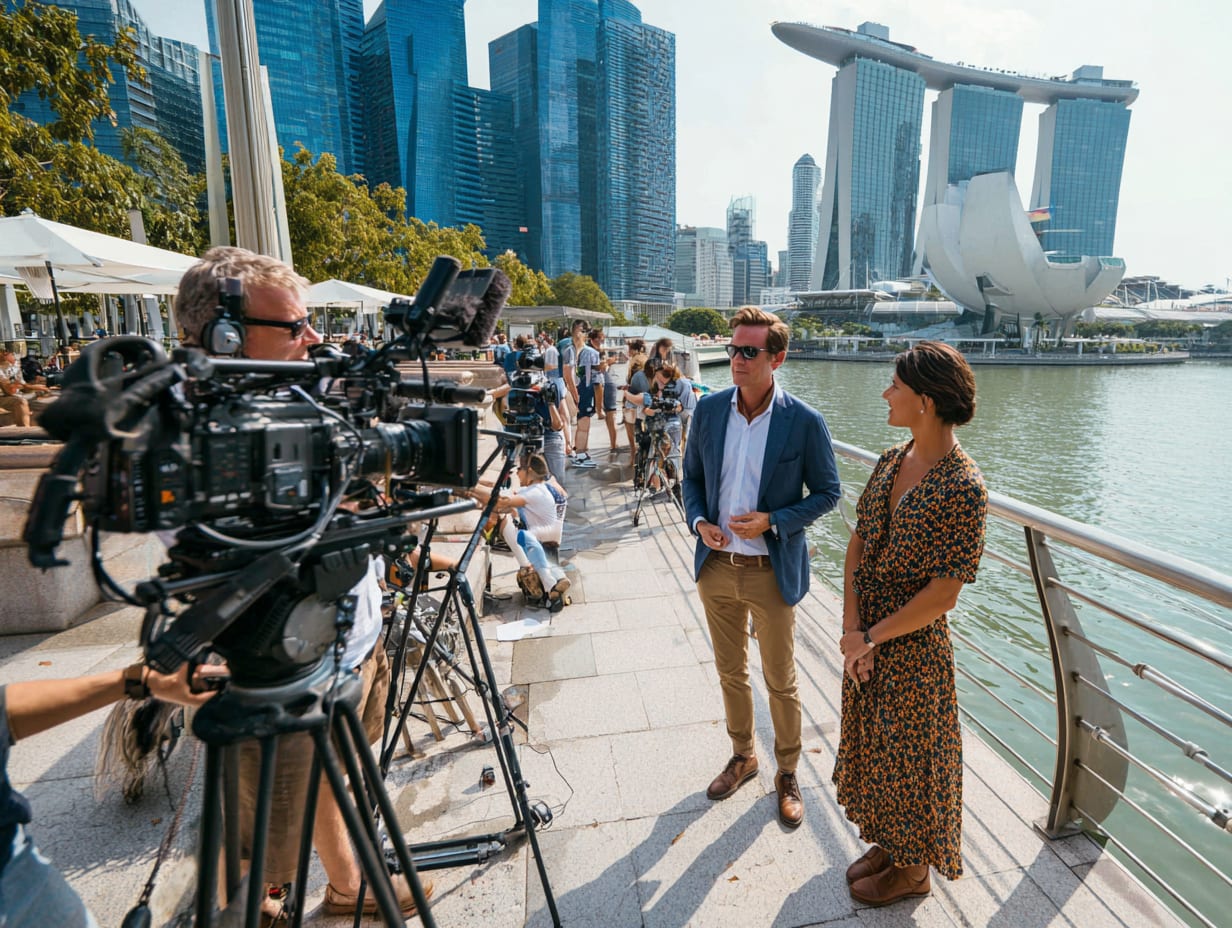
How to choose a video production agency in Singapore

If you have ever signed a video production agency in Singapore on a 12-month retainer and quietly regretted it by month four, you are not alone. The market has dozens of capable agencies, and the difference between a good fit and an expensive mistake usually shows up in the contract long before it shows up in the work. This guide is for the person inside the brand who has to choose: the three kinds of partner you can hire, what you are actually paying for, the questions that surface a stretched agency, and the red flags that should kill a deal before it starts.
Where this guide is coming from: 90 Seconds is one of the three partner types below, and we are naming that up front so you know the source. Singapore is our third-largest shoot location globally, with 112 video projects shot there in the last 12 months, behind only Sydney and London. We work with HSBC, Standard Chartered, UBS, Microsoft, Kyndryl, Cushman & Wakefield, Deloitte, EY and KPMG, plus 4,500+ other brands across 110+ countries. The rest of this piece is honest about when a traditional agency is the right call and when it is not.
The three kinds of partner, decoded
The phrase "video production agency Singapore" gets used for three very different operating models. The pricing, the process, and the failure modes are different in each.
1. The full-service creative agency
Strategy, concept, script, and production under one roof, often part of a larger advertising group. Best in class for big-idea campaign work and brand films where the creative leap matters more than production efficiency.
Strengths: strategic depth, senior creative talent, integrated thinking across channels. Weaknesses: high overheads passed through to the brand, slower delivery, weaker fit for always-on or repeatable work. Right when: you are commissioning a hero campaign, a rebrand film, or a category launch.
2. The production house or production agency
A pure execution shop. You bring the script and the brief, they bring the crew, kit, location, and edit. Singapore has an excellent production house ecosystem, with strong directors and DOPs who work freelance across the region.
Strengths: craft quality, fair pricing, fast scheduling, no creative overheads. Weaknesses: limited strategic input, single-market by default, harder to scale across regions or formats. Right when: you have the creative, you know the format, and you need it shot well.
3. The video creation platform
A productised model where the brand briefs once, the platform scopes the order, and a curated team of vetted Creator Partners delivers. Designed for repeatable, multi-market, multi-format work where the volume is the problem the brand is trying to solve.
Strengths: speed, scalability, a single point of accountability, transparent pricing, multi-market by default. Weaknesses: less suited to very high-concept hero work that depends on a single named auteur director. Right when: you are running an always-on programme, a multi-market rollout, or a content engine with monthly outputs.
90 Seconds is in this third category. We are naming it once here so you know where this guide is coming from.

What a video production agency in Singapore actually sells
When you sign a contract with a video production agency in Singapore, you are not really buying videos. You are buying access to a small group of people who, on a good week, will make your videos better than you could brief them to be, and on a bad week will absorb chaos so you do not have to.
Specifically, three things, in this order:
- Senior producer attention. The single biggest predictor of whether your project ships well.
- Curated craft talent. Directors, DOPs, editors, motion designers and sound mixers, all freelance, all known to the agency.
- Process infrastructure. Scheduling, review, version control, asset management, and the unglamorous middle of getting work done.
Agencies that lead with the showreel are selling craft. Agencies that lead with case studies are selling outcomes. The strongest agencies in Singapore sell process, because process is what compounds across a year of work.
Kyndryl's leadership film, delivered across multiple markets through 90 Seconds at a cadence (67 signed projects in 12 months) that a single Singapore agency cannot structurally support.
The org chart, decoded
A typical mid-sized Singapore video production agency has the roles below. Some are full-time, some are contracted. Knowing which is which tells you where the agency is strong and where it is fragile.
| Role | Usually full-time | Usually freelance |
|---|---|---|
| Executive producer / agency lead | Full-time | |
| Senior producer | Full-time | |
| Producer / project manager | Full-time | |
| Creative director / writer | Mixed | Mixed |
| Director | Freelance | |
| Director of photography | Freelance | |
| Camera assistant, gaffer, grip | Freelance | |
| Sound recordist | Freelance | |
| Editor (offline) | Mixed | Mixed |
| Online editor / colourist | Mixed | Mixed |
| Motion designer / animator | Mixed | Mixed |
| Sound designer / composer | Freelance |
Two flags worth noticing in an agency proposal:
- All freelance, no permanent producer. The agency is a roster, not a team. Scheduling and accountability will both be soft.
- All in-house, no freelance roster. The agency is over-headed and will charge you for the standing capacity even when you do not need it.
The healthiest Singapore agencies are 60 to 70% permanent producer and post staff, with a strong, repeated freelance roster on the craft side. Ask for the proportion. Good agencies answer cleanly.
Want to compare your current agency's rate card against the platform model? A 20-minute call with the Singapore team maps your scope against a productised order, with line-item prices side by side. No retainer, no lock-in. Get in touch with the Singapore team.
How the rate card actually works
Singapore agencies usually quote in three ways. Knowing which one you are reading prevents most price disputes.
Day rates, line-item
The most transparent quote format. Each role is priced by half-day or full-day, and kit and consumables are listed separately. You are paying for: the working time of named people and the gear they need. Watch for: an "agency producer day rate" charged on top of the named producer day rate. Sometimes legitimate, often a margin add.
Project fixed-fee
A single price for the whole project. The agency absorbs schedule risk. You absorb scope risk. You are paying for: certainty, plus the agency's risk premium. Watch for: scope language. "One round of revisions" without a definition of "round" is a future argument.
Retainer
A monthly fee in exchange for an agreed volume or capacity, sometimes structured as a minimum spend with a top-up for overages. You are paying for: priority access, faster turnaround, a lower per-asset price. Watch for: the unused-capacity question. If you under-use the retainer in a slow month, do you carry capacity forward, lose it, or get credited?
A useful rule: if you cannot summarise the rate model in one sentence to your CFO, the model is too complicated.
What a healthy agency week looks like (and a stretched one)
If you get to visit a Singapore agency mid-week, watch for these signs of a healthy operation:
- The producers know which projects are on what milestone without checking a system.
- The freelance directors and DOPs are familiar by name, not just by reel.
- The edit suites are booked end-to-end against named projects, not "tentative."
- A single person owns each project end-to-end, and that person is in the room.
- Friday afternoons are calm.
And the warning signs of a stretched agency:
- The agency lead is on every call. They cannot scale, and you are paying for that.
- The producer assigned to your project has 11 other active projects.
- "Our editor is finalising your cut" is said about three different projects in the same hour.
- The freelance director on the proposal has not actually been booked yet.
- Friday afternoons are panic.
You can ask for any of this on a tour. Most agencies say yes.
The 8 questions to ask before you sign
Most agency briefings spend 80% of the time on the showreel and 20% on how the agency actually operates. Flip that ratio.
- Who is the named producer on my account, and what else are they running this quarter?
- Show me three projects with a similar scope, and tell me what went wrong on each one.
- What is your standard revision policy, and what is the price of a fourth round?
- Who owns the raw footage, the project files, and the music licences when the project ends?
- What is your timeline from brief to first cut, in working days?
- How do you scope across markets if I need a Bangkok or Jakarta version?
- What is your minimum order size, and what is your average?
- What does your contract say about IP, exclusivity, and termination? Read it. Not your legal team. You.
A confident agency answers these in plain language. A stretched one buffers, deflects, or promises a follow-up email that does not arrive.
The red flags that should kill a deal
In rough order of severity:
- A 12-month retainer with a minimum spend before scope is defined. This is a financing arrangement dressed as a creative partnership.
- No named producer, creative lead, or editor in the proposal. You are buying access to a roster, not a team.
- A bid 40% lower than every other bid. Either the scope is wrong, the team is junior, or the agency is buying market share at your expense. None of these end well.
- A bid 80% higher than every other bid with no explainable reason. You are paying for someone's name on the building.
- Vague IP terms. If the contract does not clearly state that the brand owns the master files, the brand does not own them. IPOS is the authority on Singapore IP rights and a good reference for what default ownership looks like.
- No multi-market story. If your business is regional and the agency cannot articulate how they deliver outside Singapore, do not assume they will figure it out.
Realistic price bands for common scopes
Singapore is a tier-1 production market. Mid-market scopes:
| Scope | Realistic SGD range | Working days |
|---|---|---|
| Single corporate video, half-day shoot | 8,000 to 20,000 | 10 to 20 |
| Single hero brand film, fully creative-led | 60,000 to 150,000 | 30 to 60 |
| Campaign with hero plus three cutdowns | 35,000 to 90,000 | 20 to 40 |
| Always-on social engine, 8 to 12 videos a month | 25,000 to 60,000 monthly | continuous |
| Multi-market regional rollout | 200,000 to 600,000 annually | continuous |
If your shortlist agencies are quoting outside these bands, ask why before you assume they are wrong.
The pilot project test
The single best way to evaluate a Singapore agency is to commission a pilot project before you sign the retainer. Pick a small, real piece of work. Watch how they brief, scope, schedule, deliver, and revise. Pay attention to who actually shows up on the call by week three. The agency you signed in week one is not always the agency you get in month three. The pilot tells you the truth.
When a platform fits better than an agency
The platform model outperforms a Singapore video production agency when one of these patterns is true:
- High-volume, multi-format, multi-market work where the volume is the point.
- Internal-comms or product-led video programmes that do not need a creative-director-level concept.
- Cross-region rollouts where a Singapore agency will subcontract anyway.
- Programmes where the brand wants visibility into scope, schedule, and cost in a single platform rather than across email threads.
The numbers behind that. 90 Seconds shot 112 video projects in Singapore in the last 12 months, our third-largest shoot location globally behind only Sydney and London. The brand families running the highest-cadence programmes on the platform (Kyndryl, HSBC, Roche, Cushman & Wakefield, Microsoft, Deloitte) average 21 to 67 signed projects per year, typically at a lower per-project cost than comparable agency quotes. That cadence is structurally hard for a traditional agency to support, because the agency model was built around 5 to 10-project years and high producer overhead.
How the operating model works. Brands brief once. A Concierge scopes and runs the order. Vetted Creator Partners deliver. The platform handles scoping, scheduling, review, version control, and asset delivery in one place. For a brand-side team that does not want to absorb the agency operating model, the difference is usually larger than the per-asset price.
Frequently asked questions
How much does a video production agency in Singapore charge?
Mid-market agency price bands: SGD 8,000 to 20,000 for a single corporate video, SGD 35,000 to 90,000 for a brand campaign, SGD 25,000 to 60,000 monthly for an always-on social engine, and SGD 60,000 to 150,000 for a creative-led hero brand film. Below those bands the team is junior. Above them you are paying for the agency's name on the building.
What is the difference between a video production agency, a production house, and a creative agency in Singapore?
A creative agency leads with strategy and concept. A production house executes against a script you bring. A production agency sits between the two with internal producers and a freelance craft roster. A video creation platform replaces the agency-side overhead with a productised order and Concierge flow.
Do Singapore video production agencies own the master files?
Only if the contract says so explicitly. Default IP behaviour leaves master files, project files, and music licences with the production agency. Brands should require ownership of all four in the contract. IPOS is the authority on Singapore IP rights.
How do I evaluate a Singapore video production agency before signing?
Run a paid pilot project. A small, real piece of work tells you more in three weeks than three pitch decks tell you in three months. Watch how they brief, scope, schedule, deliver, and revise, and pay attention to who shows up on the call by week three.
Where do Singapore video production agencies typically shoot?
CBD work clusters at Marina Bay, Raffles Place, Tanjong Pagar, and Suntec. Tech-sector work happens at One-North, Mediapolis, and Mapletree. Lifestyle and F&B shoots favour Tiong Bahru, Maxwell, Lau Pa Sat, the shophouses around Joo Chiat, and rooftop spaces in Chinatown and Keong Saik.
When is a video creation platform a better fit than a Singapore video production agency?
When the volume is the point: more than 10 videos per quarter, multi-market needs, multiple internal stakeholders ordering, or a mixed deliverable mix. Platforms compress the agency overhead and replace producer day rates with a Concierge running the order.
What to do this week
Pull your last six video invoices. Look at the per-video price, the per-video turnaround, and the number of vendors involved. If those three numbers do not look like a system, your current Singapore video production agency is the problem. The next conversation is the easy part.
If you have an agency relationship that has gone quiet, ask for an operating-model review, not a creative review. Walk through the org chart, the rate card, and the project list. Most relationships either get healthier in that meeting or end honestly. Both outcomes beat the slow drift.
Want to compare your current setup against the platform model? See how we work in Singapore, or get in touch with the team for a 20-minute scoping call, no pitch deck.

90 Seconds
Content Team