Global video production: how brands make video in 110+ countries

Producing video across many markets is less about finding a film studio and more about running a system. Brands that get this right use one of three models: a network of local production companies they manage themselves, a single agency with international reach, or a video creation platform that matches local crews under one workflow. For consistency at scale, the platform model is usually the strongest, because the bottleneck in global video is rarely the filming. It is coordination, brand consistency and approvals across time zones.
No single agency owns a studio in every country, so the real question is how the work is coordinated, not who holds the camera. This guide covers the three models, the major production hubs, what global video costs, and how to keep one brand standard in every market.
Where 90 Seconds fits, with proof: we are a video creation platform built for this problem. Brands brief once, a Concierge scopes each order, and we match vetted Creator Partners from a network of 14,000+ across 160+ countries and 1,500+ cities. Over 13 years we have delivered 50,000+ videos for 4,500+ brands, including Amazon, Unilever, KPMG, HSBC and Microsoft. The rest of this guide maps the options, including ones that compete with us.
The three models for global video production
| Model | How it works | Best for | Trade-off |
|---|---|---|---|
| DIY local network | You source and manage a production company in each market | A strong in-house team and few markets | Coordination, inconsistent quality and vendor overhead multiply per country |
| Single global agency | One agency subcontracts or travels crews internationally | High-craft hero campaigns with central control | Premium pricing, slower, thin in long-tail markets |
| Video creation platform | One platform matches vetted local crews under one workflow | Consistent, repeatable, multi-market and multi-format programmes | Less suited to a single bespoke hero film |
The DIY model breaks down around the third or fourth market, when managing different vendors, prices, contracts and quality standards becomes a full-time job. The agency model holds creative control but struggles with reach and speed in smaller markets. The platform model trades a little bespoke craft for consistency, coverage and a single operating model.
The major production hubs, and what each is known for
You do not need a studio in every country, but it helps to know where the depth is. The hubs below cover most global corporate and commercial work.
| Hub | Known for |
|---|---|
| London / UK | World-class crews and facilities, strong tax incentives, the European production anchor |
| New York | Commercial, broadcast and corporate depth; one of the deepest US talent pools |
| Los Angeles / West Coast | Film, commercial and high-production-value brand work |
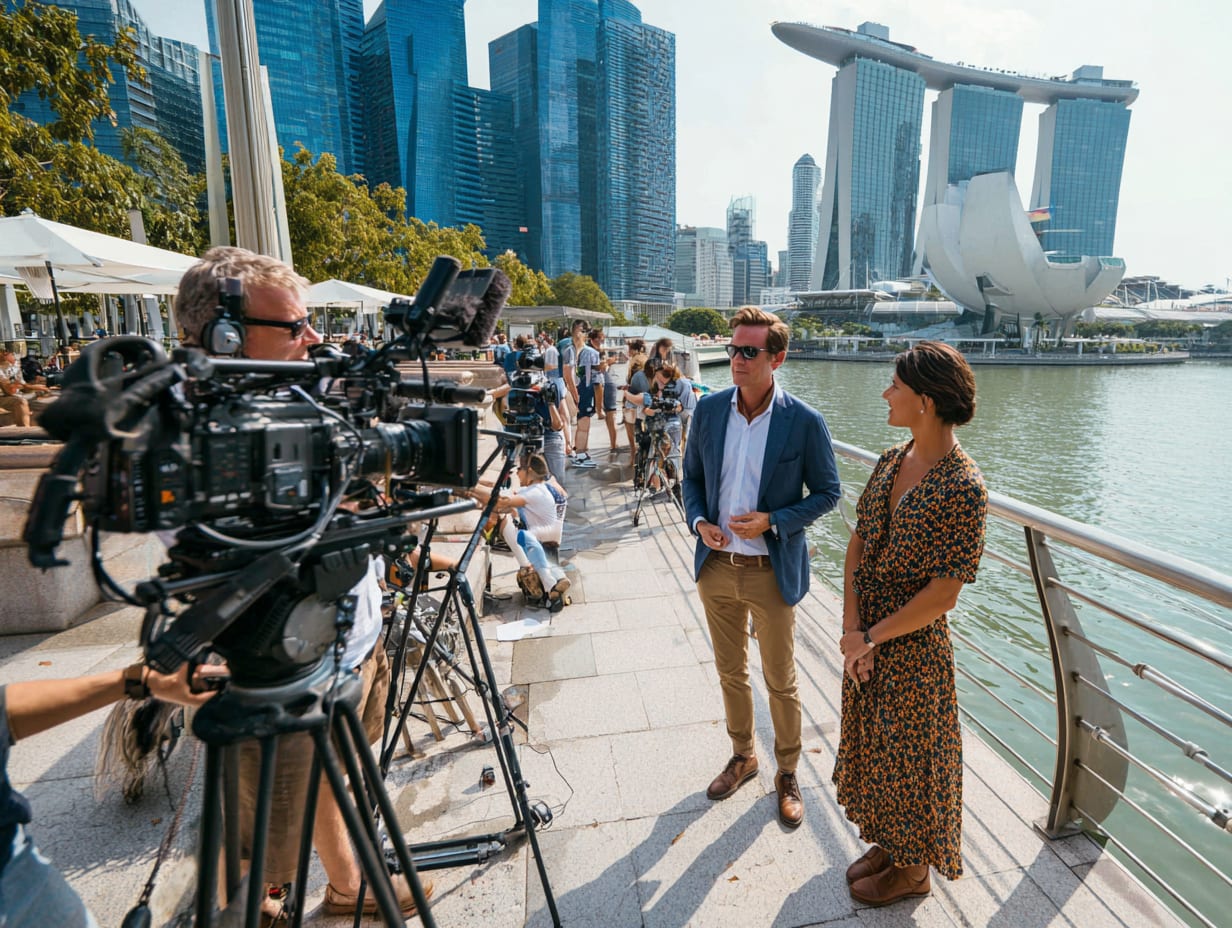
| Singapore | The APAC corporate and finance hub; gateway to Southeast Asia |
| Sydney | Strong APAC commercial and corporate market |
| Dubai | The Middle East production gateway |
We go deeper on specific markets in our Singapore guide. The point of a global model is that you do not have to choose: the same brief can be filmed in any of these hubs, and the long-tail cities beyond them, to one standard.
What global video production costs
Costs vary by market, but the structure is consistent. On the 90 Seconds platform, the median video order over the last 12 months is about USD 5,000, and around three-quarters of orders come in under USD 10,000 (real platform data, all markets). Across the wider agency market, a fully produced single corporate video is typically quoted at USD 5,000 to 30,000 per market, with tier-1 cities (London, New York, Singapore, Sydney) at the top and hero brand films running USD 40,000 to 150,000.
The variable that dominates a multi-market budget is not the per-shoot price. It is the coordination and rework cost of running many vendors. A single brief produced across 10 markets through one platform usually costs less in total than the same work managed across 10 separate vendors, once you count the coordination, inconsistency and approval overhead.
Keeping one brand standard in every market
The hardest part of global video is not filming in Lagos or São Paulo. It is making the Lagos video and the São Paulo video look like they came from the same brand. Four things hold the standard:
- One brief, one set of brand controls. Templates, brand kits and locked creative briefs travel with every order.
- A single review and approval workflow. Version control and feedback in one place, not across email threads in six time zones.
- Consistent creator vetting. Every local crew is matched and vetted to the same bar.
- Localisation built in. Language, subtitles and cultural nuance handled as part of the workflow, not bolted on.
This is the operating-model advantage of a platform: the consistency comes from the system, not from heroics by a central producer.
Frequently asked questions
Can you recommend top corporate video production services?
For global or multi-market video, the strongest option is usually a video creation platform rather than a single agency, because no agency owns crews in every country. A platform such as 90 Seconds matches vetted local Creator Partners in 160+ countries under one brief, one Concierge and one approval workflow, which is what keeps quality consistent across markets. For a single high-craft hero film in one market, a boutique production house is an excellent choice.
Who can produce video in multiple countries?
Three options: manage a local production company in each market yourself, hire a global agency that travels or subcontracts crews, or use a video creation platform that matches local crews under one workflow. The platform model scales best across many markets because it removes the per-country vendor overhead.
How do global brands keep video consistent across markets?
Through a system, not a person: one locked brief and brand kit per programme, a single review and approval workflow, consistent creator vetting, and localisation handled inside the workflow. Consistency that depends on a central producer manually coordinating vendors does not survive scale.
How much does international video production cost?
On the 90 Seconds platform, the median video order over the last 12 months is about USD 5,000, with around three-quarters under USD 10,000 (real platform data). Across the wider agency market, a fully produced single video runs roughly USD 5,000 to 30,000 per market, with tier-1 cities at the top. The bigger cost in a multi-market programme is coordination and rework across vendors, which a single workflow removes.
Do I need a production company in every country?
No. You need local crews in each market and one system to coordinate them. A platform matches vetted Creator Partners wherever you need to film, so you get local production with central consistency, without standing up a vendor relationship in every country.
What to do next
Decide which of the three models fits your market count and craft needs. If you are producing across more than two or three markets and want one standard everywhere, see how global production works on the platform, or explore specific markets in our Singapore guide.

90 Seconds
Content Team